There are many different ways to teach. In my view, there are no better or worse methods, as it all depends on the type of student and their eagerness to learn. The instructor’s enthusiasm to teach also plays a role, but that’s a topic for another post.
After many years of teaching, I have a clear understanding that every person is unique and therefore needs to be taught in a different way. The methodology will be almost the same, the information too, even the words, but you can’t teach everyone in the same manner. Experience has taught me that if we want students to understand and learn well, we have to adapt to each one of them as much as possible.
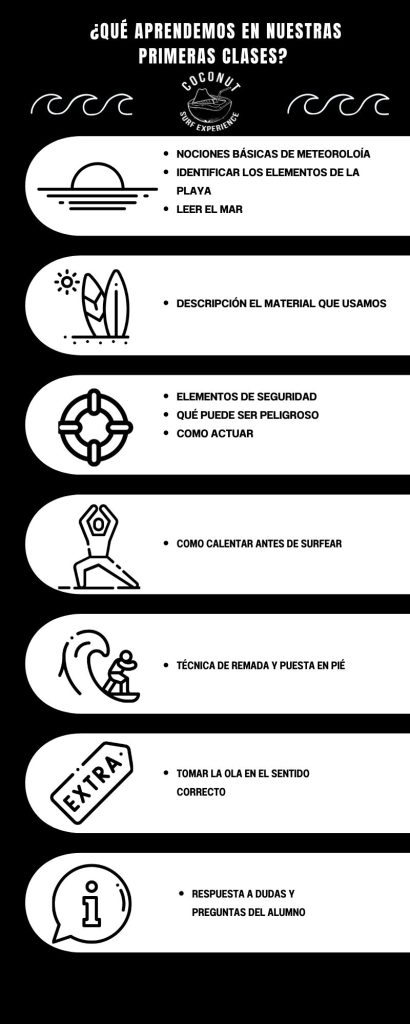
Here are the basic points we cover in our first surfing lessons. This refers to a beginner’s course that would typically last about five days. Obviously, I will generalize. We all have different physical and mental abilities, so we won’t all progress at the same pace. The topics I will present below are, in my opinion, the minimum that should be learned in an introductory course.
In a beginner’s course, the student will learn about:
- Basic meteorology concepts
- Description of the equipment we use
- Safety elements
- Paddling technique and standing up
- Taking the wave in the correct direction
- Answers to doubts and questions
BASIC METEOROLOGY CONCEPTS
To learn to surf, and by this I mean being able to surf independently without being a danger to ourselves or others, we need to learn a series of concepts to choose the right spot and time to surf. The student must learn to understand where they are, the elements that make up the beach, and the conditions for that day. There are many questions we ask ourselves before deciding where and when to surf, and even before entering the water, we ask many more. If not, we would put our lives in danger. Let’s learn to understand the sea and the elements that surround it.
DESCRIPTION OF THE EQUIPMENT WE USE
To surf, a wide variety of equipment can be used, depending on our level and the type of wave we are going to surf. Let’s understand the type of equipment we use and why this one and not another. This way, it will be easier for us to understand how to use it and later, when renting or buying, we will have an idea of what we need.
SAFETY ELEMENTS
Before going into the water, we must be clear on how the class will be conducted. How our instructor will be positioned and how the students will move in the water to minimize the possibility of colliding with another person. Similarly, we need to be clear about where the board will be in relation to our body to avoid it hitting us. The student must be very clear about what can be dangerous and how to react.
WARMING UP BEFORE SURFING
Before doing any sport, we need to warm up. The same goes for surfing. Warming up is often overlooked, sometimes due to laziness, eagerness to get in the water, or simply ignorance. Not warming up one day might not be serious, but over time and with age, believe me, we will realize that our body needs to have moved properly before lying on our board. But what should we warm up?
PADDLING TECHNIQUE AND STANDING UP
This is probably one of the only points that all schools will teach in a beginner’s course. If you take a course and they don’t teach you this before going into the water, worry. This might also be the area with the most differences. There are many ways to stand up. Everyone will give a thousand arguments in favor of their teaching method. Probably many of them are correct and a few are not. However, I must say that some instructors teach some wild methods. Eventually, there comes a moment when one either teaches to stand up at all costs or teaches a proper surfing technique that can be adapted to the student. These are two very different things. Every master has their own style.
TAKING THE WAVE IN THE CORRECT DIRECTION
I include this as an extra since it will depend on the student’s learning pace.
ANSWERING STUDENT DOUBTS AND QUESTIONS
In my opinion, this is one of the most important things. Instructors teach but also learn a lot from each of our students. The student will always have many questions or doubts as they are learning new things. It is common for them to want to ask. We must listen to our students to teach them what they truly feel they need to learn.
Good waves!